As an Amazon Associate, this website earns from qualifying purchases.
The short answer
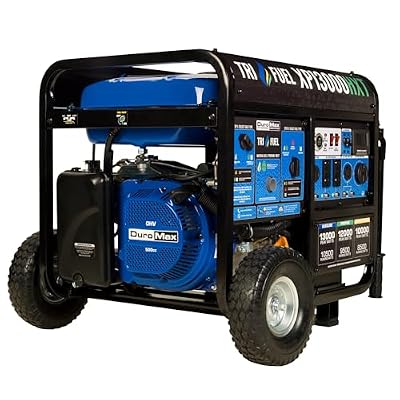
Champion 201176, Westinghouse WGen11500TFc and DuroMax XP13000HXT supply 120/240 V. They are candidates only after your exact pump load and start demand fit the chosen fuel rating. Hardwired pumps need a designed transfer connection.
Best generator for well pump: Well pump backup starts with the pump, not the generator. Find the nameplate or control box label. Note its voltage, running watts and starting data. Well depth alone does not tell you the motor's demand.
This guide compares three tri-fuel portable generators. Each lists 120/240 V output from its maker. We use only published figures. A generator's output is a screening number.
It is not a full match for your pump, wiring or fuel supply. For whole-home planning, see our best generator for home guide.
The Champion 201176 is an open-frame inverter generator. Like other inverter units, it uses an alternator plus power electronics. Champion lists 120/240 V output. That gives it a chance to serve a 240 V pump circuit.
It still depends on the transfer equipment and panel design.
Champion publishes running watts for three fuels. Gasoline is 7,250 W. Propane is 6,525 W. Natural gas is 5,875 W.
That is a 1,375 W drop from gasoline to natural gas.
Plan around the fuel you will really use. If you expect to run on natural gas, use 5,875 W. The gasoline figure would overstate your margin on that fuel. Your total running load must fit under the chosen fuel's figure.
Champion specifies 9000 W starting on all three fuels. Its lower natural-gas running output still limits the steady load. Match the circuit connection and starting load separately.
Champion lists 14 hours on gasoline and 12 hours on propane at 25% load, and no natural gas runtime. That does not say how long it lasts at your load. Duration is part of a real fit check. Ask for the owner's manual before you buy.
Natural gas use needs its own checks. Supply pressure, flow and the exact instructions matter. Electric watts do not tell you gas flow. A licensed gas professional handles any fuel connection.
This model may suit you under certain conditions. Your pump nameplate must match its voltage. Your total running load must fit the fuel figure you plan to use. Champion publishes its starting rating but not how long the surge lasts, so confirm that in the manual.
Match the 9000 W starting figure to your pump's startup draw.
Placement follows the same rule as any engine generator. Run it outdoors, at least 20 feet from the home. Point the exhaust away from the house. Never run it indoors or in a garage, even with doors open.
The Westinghouse WGen11500TFc has the highest published running watts of these three. It lists 120/240 V output. It also publishes peak watts on all three fuels.
On gasoline, it lists 11,500 W running and 14,500 W peak. On propane, it lists 10,500 W running and 13,500 W peak. On natural gas, it lists 9,500 W running and 12,000 W peak. Running watts drop 2,000 W from gasoline to natural gas.
Those peaks help with a startup check. Your total running load must stay under the running figure. Your startup total must stay under the peak figure for that fuel. The startup math appears in the factors section below.
Westinghouse also lists gasoline runtime. It is 19 hours at 25% load. It is 9.5 hours at 50% load. These are the maker's stated conditions.
Runtime at your real load may differ. No propane or natural gas runtime appears in our checked source.
The current product page also describes pairing with a WATS200 automatic transfer system. This guide does not compare that system's full requirements. So automatic operation stays unresolved here. Use the exact compatible documents before relying on it.
Even automated, the generator still needs safe outdoor placement.
The main drawback is size. Westinghouse lists a 230 lb dry weight. Moving it into position may take more than one person. Plan its outdoor spot before it arrives.
This model may suit you under clear conditions. Your pump must match its 120/240 V output through approved transfer gear. Your running total must fit the fuel figure you plan to use. Your startup total must fit that fuel's peak.
You must also have room to place it safely outdoors.
For natural gas or propane, check fuel separately. Supply pressure, flow and exact instructions all matter. A licensed professional handles any gas work. Do not modify fuel parts yourself.
The outdoor rule does not change for a bigger unit. Keep it at least 20 feet from the home. Point exhaust away from windows and doors. Never run it in a garage, even with doors open.
The DuroMax XP13000HXT is a tri-fuel portable generator. Its current manual lists running watts between the other two picks: 10,500 W on gasoline and 10,000 W on propane.
The manual filename marks revision 02072025. The older sales sheet, page 2 gives lower propane and natural-gas ratings. These are current document figures, not proof that every unit has those ratings.
Match your unit's label and manual revision before sizing loads. Starting watts do not promise a motor will start or state how long peak output lasts.
The current natural-gas running rating is 9,000 W.
The current manual shows a 1,500 W drop from gasoline to natural gas. Size your load to the fuel you will use. A natural-gas plan uses the rating for your exact unit and manual revision.
The 120/240 V output comes from amperage figures in the product table. That points to 240 V availability. Still, confirm the exact receptacles in the manual. The receptacle must match your approved transfer equipment.
The DuroMax manual above gives current starting watts for each fuel. Older documents differ. That revision check is a real limit for well-pump planning. A starting-watt figure alone does not prove that your pump will start.
No maker here publishes how long its surge lasts, so confirm that in the manual.
Check runtime at the stated fuel and load before planning an outage. Handling also needs its own check. Use the current manual for your exact unit and keep its revision with the load plan.
This model may suit you under certain conditions. You want three fuel options with more running watts than the Champion. Your pump nameplate voltage must match its output. Your running total must fit the chosen fuel's figure.
You must also match its starting rating for your fuel to your pump's startup draw.
The current DuroMax manual lists 1,000 W less running output than the Westinghouse on gasoline. The gap is 500 W on propane and natural gas. It lists more than the Champion on each fuel. Those gaps matter only against your own load total. Bigger output does not prove a fit by itself.
Gas fuel use needs separate checks. Supply pressure and flow are not shown by watts. Follow the exact instructions for that fuel. Leave gas connections to licensed trades.
Place it outdoors like the others. Keep it at least 20 feet from the home. Aim the exhaust away from the house. Never run it indoors or in a garage.
Factors to consider when choosing the best generator for well pump backup
Read the pump nameplate first
The nameplate or control box label is your starting point. Look for voltage, running watts and starting data. Some labels list amps instead of watts. Volts times amps gives volt-amps, not watts.
You need a known power factor to convert.
Well depth is not the same as motor demand. Depth may affect pump selection, but it gives no watt figure. Use the motor's own rating instead. If the label is missing or worn, ask your well contractor for the model data.
Startup math done the right way
First, find R. R is the running watts of everything running at once. Include the pump's own running watts in R.
Next, find each motor's starting gap. That gap is its total starting watts minus its running watts. If a result is negative, treat it as zero.
If only one motor starts at a time, add the largest single gap to R. If motors may start together, add every starting gap to R. Multiply each gap by how many of that unit start at once.
Do not add a motor's full starting watts on top of R. That counts its running watts twice. Do not leave its running watts out of R either. Do not assume motors never start together.
A pump and another motor may cycle at once.
Compare the results to the generator's figures for your fuel. R must fit under running watts. The startup total must fit under peak watts. Westinghouse lists peak watts. Champion and DuroMax list starting watts.
120 V versus 240 V service
Your pump's nameplate sets the voltage. Do not assume either 120 V or 240 V. All three picks list 120/240 V output. That output still has to reach the pump circuit through approved equipment.
A 120 V generator does not bar every transfer system. Reliance Controls sells the TF152W single-circuit transfer switch. It is rated 125 V and 15 A for one circuit. It lists 1,875 maximum generator running watts.
That rating does not make a 240 V pump work on 120 V.
No adapter can create a voltage the generator does not make. Generac notes this in its manual transfer guidance. An RV receptacle on a generator does not prove approved home transfer use.
Battery power stations: surge versus sustained output
Battery stations list rated output and stored energy separately. Watts are power. Watt-hours are stored energy. The BLUETTI AC200L lists 2,048 Wh and 2,400 W rated output.
Both list 120 V US outlets. So neither can feed a 240 V pump directly from those outlets. A rated output is sustained power, not a surge rating. BLUETTI AC200L lists 3600 W surge; Jackery Explorer 2000 v2 lists 4400 W surge.
Those figures do not create 240 V output or establish a particular pump start. So a pump start cannot be confirmed here.
Transfer equipment and licensed installation
A transfer switch or listed interlock isolates the utility from the generator. Generator, switch, inlet, panel and circuits must all match. Reliance Controls documents a six-circuit 30 A manual transfer kit. It includes a switch, inlet and ten-foot cord.
That lists contents, not compatibility.
Generac documents the HomeLink 6853 manual transfer switch. It is a 30 A pre-wired kit. An interlock must be listed for your exact panel and accepted locally. Installation belongs to licensed electrical trades.
Never backfeed a wall outlet.
Fuel choice and supply
Fuel changes usable output on all three picks. For these listed models, gasoline gives the most running watts. Propane gives less. Natural gas gives the least.
Gasoline availability varies by area during outages. Natural gas service is not guaranteed either. Fuel pressure, flow and exact instructions are separate checks. Watts never tell you gas flow.
Leave all gas work to licensed professionals.
Safe placement and refueling
The CPSC carbon monoxide guidance is clear. Use engine generators outdoors, at least 20 feet from homes. Point exhaust away. Never use them indoors or in garages with open doors.
The CPSC portable generator safety alert adds more steps. Run it on a dry surface under an open canopy-like structure. Follow the maker's rain rules. Shut it down and let it cool before refueling.
Install CO alarms and get to fresh air if one sounds. Read more in our generator safety guide.
Published-source method and conditional verdict
Figures come from maker pages and documents. DuroMax ratings follow its current manual. We keep each fuel's running and starting ratings together. An older DuroMax sheet differs from its current manual.
DuroMax ratings need a unit-revision check.
We used no price, appliance wattage chart or horsepower table. We did not run hands-on tests.
Our verdict is conditional. If your sized load fits 5,875 to 7,250 running watts, screen the Champion. Check its 9000 W starting figure against your pump's startup draw. If you need more running watts and listed peaks, check the Westinghouse.
Plan for its weight. Compare the DuroMax if your loads fit its current 9,000 to 10,500 W running range. Match your unit revision, chosen fuel and starting demand first.
Give the pump its own load record
Keep the pump separate from general house loads. Record the exact pump model and the source for its electrical data. If a control box has its own model, include that too. A broad description such as deep-well pump does not identify a starting load.
A horsepower label alone also leaves part of the electrical task unresolved.
Write down what else will stay on when the pump starts. A heater or another motor can change the required supply. Do not assume the pump will always start by itself. If the start sequence is uncertain, keep that uncertainty visible.
The generator choice needs to cover the intended routine, not an easier routine that happens only sometimes.
Keep water demand separate from generator output
First decide the water use that matters during an outage. The aim may be a limited essential-water routine. It may be a larger home plan with more loads. That decision changes what else you allow to run.
It does not change the pump's own starting demand.
Keep the generator rating tied to the selected fuel. A plan checked on gasoline must be checked again for propane or natural gas. Record the final result with the transfer equipment design. If any needed figure remains unknown, the shortlist remains a set of candidates.
Ordering a larger machine does not resolve an unknown connection or fuel supply.
Best generator for well pump FAQs
What size generator do I need for a well pump?
Add the running watts of everything that runs at once, including the pump. Then add the largest starting gap if one motor starts at a time. Add all gaps if motors can start together. Compare the totals to the generator's running and peak watts for your fuel.
Does well depth tell me how many watts my pump needs?
No. Depth does not give a watt figure on its own. The motor's nameplate or control box label lists its real ratings. Use those numbers for sizing.
If the label is missing, ask your well contractor for the pump model and its published data.
Can a battery power station run a 240 V well pump?
The two battery stations in this guide list 120 V US outlets. They cannot supply 240 V from those outlets. No adapter can create missing voltage. Their rated output is also sustained power, not surge.
BLUETTI AC200L lists 3600 W surge and Jackery Explorer 2000 v2 lists 4400 W surge. The 120 V output remains a separate limit.
Is it safe to run a generator in a garage for a well pump?
No. CPSC says to use engine generators outdoors, at least 20 feet from homes. Point exhaust away from the house. Never run one indoors or in a garage, even with doors open.
Install CO alarms and leave for fresh air if one sounds.