As an Amazon Associate, this website earns from qualifying purchases.
The short answer
Westinghouse iGen2550DFc covers light 120 V loads. Champion 201176 and DuroMax XP13000HXT offer larger 120/240 V options. Use propane running ratings for load planning, then check tank supply and safe outdoor placement.
Propane generator for home: Propane can be a useful backup fuel. However, the fuel you choose changes the power you get. This guide compares three propane-capable portable generators using each maker's published specifications.
For each model, we list propane running watts and voltage. We also cover a real drawback for each one. After the picks, you will find guidance on startup math, tank sizing and cold weather. That section also explains how portable units differ from standby systems.
The iGen2550DFc is a compact dual-fuel inverter. It runs on gasoline or propane. Westinghouse states a weight of 43 lb. Think through the full setup you must handle, including fuel and cords.
A stated weight does not measure carrying comfort or prove that a lift suits you.
On gasoline, Westinghouse lists 1900 W running and 2550 W peak. On propane, the figures are 1700 W running and 2300 W peak. Output is 120 V only. If you plan to use propane, build your load list around 1700 W running.
Do not use the gasoline figure.
The maker lists an RV TT-30R outlet. An RV outlet does not prove the unit is approved for a home transfer system. Westinghouse also describes this model as not transfer-switch-ready. That statement comes from the maker, so treat it as the answer for this model.
A 120 V output does not rule out every transfer product on the market. For example, Reliance Controls lists the TF152W as a 125 V, 15 A, single-circuit transfer switch. That rating describes the switch. It does not make the switch compatible with this generator.
Westinghouse's not-ready statement still applies here.
Who it may suit: This model may suit a home that needs a few small plug-in loads during a short outage. You must first check each appliance's running watts, starting watts, voltage and plug type. You also need to know how long each load must run. Without that data, we cannot say whether any named appliance will fit.
Real drawback: The ceiling is low. It offers 1700 W running on propane, with 120 V only. It also lacks a documented path to home transfer equipment. Any 240 V load is out of reach. An adapter cannot create a voltage the generator does not produce.
Like every engine generator, it needs safe outdoor placement. The CPSC says to run portable engine generators outdoors, at least 20 feet from homes, with the exhaust pointed away. Never run one indoors or in a garage, even with the doors open.
The Champion 201176 is an open-frame inverter. It runs on three fuels: gasoline, propane and natural gas. Champion lists 120/240 V output. That widens the range of documented connection options compared with a 120 V-only unit.
Champion's running watts by fuel are listed below.
Gasoline: 7250 W
Propane: 6525 W
Natural gas: 5875 W
The propane figure is 725 W below the gasoline figure. The natural gas figure is 650 W below propane. A plan built on the gasoline number would overstate propane output for this model. Use the line for the fuel you will actually run.
Natural gas support can help homes that already have a gas service. Still, gas supply is not guaranteed in every outage or location. A generator also needs the right fuel pressure and flow, which you cannot infer from electric watts. Exact connection instructions come from Champion's documents.
The actual gas work belongs to licensed trades.
Who it may suit: This model may suit a home planning to back up a set group of essential loads through matched transfer equipment. The 240 V output is a starting point, not a final answer. The generator's outlet, the transfer switch's rating, the inlet, the cord and your panel must all match. Each product's instructions and your local rules decide that. A licensed electrician should do the install.
Real drawback: Its open-frame engine needs outdoor placement and a compatible fuel supply. The gasoline figure of 7250 running watts is not its propane figure of 6525. Automatic-system compatibility is not established in this comparison. Do not assume an unsupported controller can make the setup automatic.
An inverter still has an alternator plus power electronics. Champion's spec page does not prove this unit's power quality beats every other generator type. Placement rules match any portable engine unit. Run it outdoors, at least 20 feet from the home, with the exhaust pointed away.
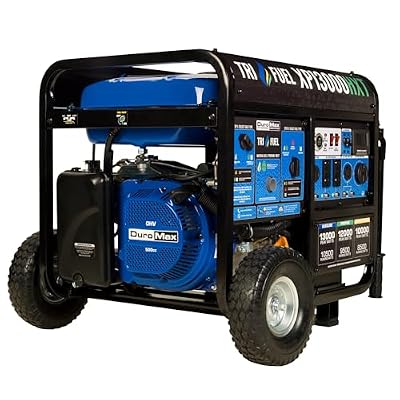
The DuroMax XP13000HXT has the highest listed running watts of these three picks. It is a tri-fuel portable generator. The amperages in DuroMax's product table indicate 120/240 V output.
The manual filename marks revision 02072025. The older sales sheet, page 2 gives lower propane and natural-gas ratings. These are current document figures, not proof that every unit has those ratings.
Match your unit's label and manual revision before sizing loads. Starting watts do not promise a motor will start or state how long peak output lasts.
The current DuroMax manual gives these running watts by fuel.
Gasoline: 10,500 W
Propane: 10,000 W
Natural gas: 9,000 W
The current propane rating is 500 W below gasoline. The natural-gas rating is another 1,000 W lower. Use the propane rating for a propane load plan, after matching your unit revision.
The current manual lists 12,500 W starting on propane and 11,250 W on natural gas. Older maker figures differ. Use the current set only after matching the unit label and manual revision. A peak watt rating does not state its duration or prove a motor will start.
Who it may suit: This model may suit a home with a longer essential-load list than the Champion can handle on propane. The higher running watts give a larger budget for your loads. However, a larger number does not prove that any named appliance will fit. You still need each load's running watts, starting watts, voltage, receptacle and run time.
Its 120/240 V output does not, by itself, confirm a match with any specific transfer switch. Check DuroMax's amperage table for your chosen fuel and voltage. Then compare it with the transfer equipment's documents. A licensed electrician should confirm the full setup.
Real drawback: The older sales sheet differs from the current manual, so the unit revision needs checking. This is an open-frame engine unit. Remote start is not an automatic standby system. It still needs safe outdoor placement each time it runs.
The CPSC safety alert asks for a dry surface. If you need cover, it suggests an open, canopy-like structure. Follow any rain-use rules in the manual. Never touch the unit with wet hands.
Never plug a generator into a wall outlet to backfeed the home.
Factors to consider when choosing propane generator for home
Fuel-specific running watts
Each of the three picks lists lower running watts on propane than on gasoline. This is a finding about these listed models only. Other models need their own spec checks.
Here is the propane drop for each pick:
Westinghouse: from 1900 W to 1700 W
Champion: from 7250 W to 6525 W
DuroMax: from 10,500 W to 10,000 W in the current manual
The Champion and DuroMax drop again on natural gas.
The practical rule is simple. Find the running watts line for your main fuel. Use that number when you build your load list. For more on how fuel choice works on these machines, see our dual fuel generator guide.
Startup math for motor loads
Some loads draw more power for a moment as they start. Your plan needs two numbers for each load: running watts and total starting watts. Get both from each appliance's nameplate or manual. This guide does not list appliance wattages, because they vary by model.
First, find R. R is the total running watts of every load that will run at the same time. That includes any motor you plan to start.
If only one load starts at a time, add the single largest starting gap to R. A starting gap is a load's total starting watts minus its own running watts. Use the gap from the same load, not a mix of numbers from different loads.
If loads may start together, add every starting gap to R. Multiply each gap by the number of units starting at once. Treat any negative gap as zero.
Do not add a load's full starting watts on top of R. That counts its running watts twice. Also, do not leave a motor's running watts out of R and add only its gap. That undercounts the total.
Do not assume motors never start together. Some may cycle at the same moment.
Compare your result with the generator's documented figures for the fuel you will use. A spec sheet number is a screening tool. It is not a full compatibility result.
Watts, volt-amps and watt-hours
These units are easy to mix up. According to the Department of Energy style guide, watts and kilowatts measure power. Watt-hours and kilowatt-hours measure stored energy. 1000 watts equals 1 kilowatt.
For AC power, volts times amps gives volt-amps. You cannot treat volt-amps as watts unless the power factor is known. That matters when a label lists only volts and amps. Watts times hours gives watt-hours.
That figure tells you how much energy a load uses over a set time.
Voltage and connection documents
Voltage decides which loads and equipment a generator can supply. A 120 V-only unit cannot run a 240 V load. An adapter will not fix that. Even so, 120 V output alone does not rule out every transfer product.
A 120/240 V output does not, by itself, prove a match with any specific switch. Generac's guidance explains that manual transfer equipment keeps utility power and generator power apart. It also says the generator, switch, inlet, panel and circuit design must all match. An interlock must be listed and accepted for your exact panel and local rules.
Kits show why the details matter. The Reliance Controls 306CRK is a six-circuit, 30 A manual kit. It includes a switch, an inlet and a ten-foot cord. The Generac 6853 is a 30 A pre-wired manual transfer kit.
These sheets list what each kit contains. They do not confirm a fit with any of our picks.
All install work belongs to licensed trades. Do not make any electrical, neutral or gas changes yourself. Never bypass safety protection.
Tank size versus usable runtime
The amount of fuel in a tank is not the same as runtime. Runtime depends on how fast the generator burns fuel at the load it is carrying. A heavy load burns fuel faster than a light one. The same tank can last a very different number of hours.
Champion publishes up to 12 hours on propane at its stated 25 percent load, using a 20-pound cylinder for the 201176. Keep propane cylinders upright and outdoors, away from ignition sources, and never in a garage or the home. That source condition is not a promise for your mixed household load. This comparison does not supply a common propane burn-rate curve for all three picks. Do not infer actual used fuel from nominal cylinder size alone.
Fuel delivery is a separate check from fuel quantity. The required pressure, hoses and regulator come from the exact manual. Local suppliers and licensed gas trades handle tank and line work. Gasoline backup also varies, since availability during an outage depends on where you live.
Cold-weather limits
Cold weather can change how a propane setup performs. Our sources for these three picks list no temperature limits or cold-weather kits. For that reason, this guide does not state a cutoff for any model.
If you live in a cold climate, ask the maker for written cold-weather guidance for your exact model. Ask your propane supplier about tank and regulator needs, too. Do not rely on general claims about how propane behaves in the cold.
Portable versus standby systems
Standby generators are permanent installs. They are not picks in this roundup. Still, their published specs show the same fuel effect. For example, Generac's Guardian 26 kW sheet lists 26 kW on propane and 22.5 kW on natural gas, rated at 240 V.
Generac also publishes an indicative US total of $8,000 to $16,000 for a full install. That figure is maker guidance, not a quote. Site, fuel line and permits change the real cost.
Standby clearances come from that model's own manual and local rules. The 20-foot portable rule does not set standby distances.
Some portables have documented automatic options. For example, Westinghouse describes pairing its WGen11500TFc with a WATS200 automatic transfer system. Follow the WATS200 manual for the system's full requirements. So automatic operation stays unresolved for our three picks.
Even an automated engine generator still needs safe outdoor placement.
How we built this comparison
We used maker pages and sheets, plus CPSC and Department of Energy documents. DuroMax ratings follow its current manual. We did no hands-on testing. An older DuroMax sheet differs, so check your unit's revision.
DuroMax is one such case: its current manual and an older sheet differ.
This article compares published output, voltage and connection limits. It does not provide a common noise test or measured runtime curve across the three models. Exact source conditions matter. Your own load records complete the demand calculation.
The documented installation requirements complete the connection check.
Conditional verdict
If you need a few small 120 V plug-in loads, the iGen2550DFc may fit. Check every load against its 1700 W propane rating first. Do not plan a home transfer connection with it.
If you need essential circuits through matched transfer equipment, compare the Champion 201176 and DuroMax XP13000HXT. Champion lists 6525 W running on propane. The current DuroMax manual lists 10,000 W. Match the exact unit revision and starting demand for your chosen fuel.
If you want a permanent, automatic system, compare standby options with a licensed installer.
Propane generator for home FAQs
Does propane make a generator safe to run indoors?
No. The CPSC says engine generators must run outdoors, at least 20 feet from homes, with the exhaust pointed away. Never run one indoors or in a garage, even with the doors open. Keep CO alarms working at home.
If an alarm sounds or you feel sick, get to fresh air right away.
How long will a propane tank run my generator?
Runtime depends on usable fuel and burn rate at the actual load. Champion lists up to 12 hours at its stated 25 percent load with a 20-pound cylinder for the 201176. That does not establish another model's runtime. Use documented consumption or a measured observation for your own estimate.
Can I plug a generator into a wall outlet?
No. The CPSC warns never to backfeed power through a wall outlet. A home connection needs transfer equipment that keeps utility power and generator power apart. The generator, switch, inlet and panel must all match.
A licensed electrician should install it, following each product's instructions and local rules.
Is natural gas better than propane for these models?
It depends on your supply and your loads. The Champion 201176 and DuroMax XP13000HXT both list lower running watts on natural gas than on propane. A gas service also needs the right pressure and flow for the generator. Licensed trades must handle the connection, and gas supply is not guaranteed.
Why do running and starting watts both matter?
Running watts cover the steady load you carry. Starting watts cover the short surge when a motor starts. First, add up all running loads. Then add the largest starting gap if loads start one at a time.
If loads can start together, add every gap instead.