As an Amazon Associate, this website earns from qualifying purchases.
The short answer
These three Generac packages cover different planned loads and switch arrangements. Compare the exact fuel rating and order contents before choosing. A whole-house product label does not prove that every appliance can run at once.
Choosing the best whole house generator starts with your home's load, not a brand name. This guide compares three standby models from maker documents. We list each model's rated output on each fuel, plus voltage and transfer equipment notes. Rated output alone does not prove a model fits your home.
Your running and starting loads, fuel supply, transfer equipment and local code all matter. For broader options, see our guide to the best generator for home.
This pick is the 7290 generator-only option. The linked family sheet also covers related switch packages. Generac's spec sheet lists 26 kW maximum continuous output on liquid propane. It lists 22.5 kW maximum continuous output on natural gas.
The rated voltage is 240 V.
The gap between fuels is 3.5 kW. That gap matters when you plan loads. If your home uses natural gas, plan against 22.5 kW. Planning against the propane figure could leave you short.
This model may suit you if a load calculation shows you need more than about 20 kW. It has the highest documented ratings of the three picks. That makes it the first one to check when your planned load exceeds the other two.
The selected 26 kW listing is generator-only. Transfer equipment and the installed scope need a separate check. A higher rating does not prove it can start a given motor load. You still need the installation manual and a licensed contractor.
They confirm fuel line sizing, transfer equipment and placement.
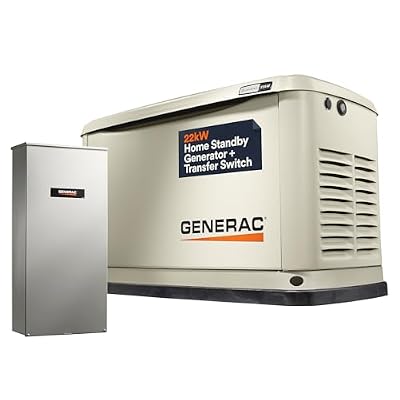
The 7043 package suits an installed load plan below the larger 26 kW option. Generac lists 22 kW on propane and 19.5 kW on natural gas. Use the second figure for a natural-gas design.
This package includes a 200 A outdoor smart transfer switch. The switch rating describes the connection hardware. It does not mean the generator supplies that much current under every load.
The drawback is lower fuel-specific capacity than the 26 kW unit. If several large loads can start together, a running-watt subtotal alone cannot settle the choice. Ask the installation quote to state which loads run together and which are shed. Keep the exact generator revision and switch model on the order.
The 7225 package is a smaller automatic backup choice. The 7225 listing is a 14 kW generator with a 200 A transfer switch. Generac's 14 kW family page lists 14 kW on both natural gas and propane. That page shows the generator-only 7223 variant, so use the exact 7225 order to confirm package contents.
This is a candidate for a smaller designed load list. It may make more sense than buying a larger unit for loads you do not need during an outage. First divide the house into essential loads and optional ones. The number of rooms is not a power measurement.
The drawback is the smaller output ceiling. A packaged switch does not add starting capacity or make every circuit usable at once. If the selected loads exceed the available output, reduce the outage plan or assess another size. Do not rely on a whole-house label to resolve that mismatch.
Factors to consider when choosing best whole house generator
Whole house or essential circuits
A "whole house" label does not mean every circuit can run at once. Whether a model covers your whole home depends on your total load. If the load exceeds the rating, an installer may back up only chosen circuits. That is an essential-circuit setup.
Decide which setup you want before comparing quotes. A whole-home plan needs output above all loads that may run together. An essential-circuit plan needs output above only the chosen loads. A plain overview is in what is a whole house generator.
Output by fuel type
The 26 kW model supplies 26 kW on propane and 22.5 kW on natural gas. The 22 kW model supplies 22 kW and 19.5 kW, respectively. The 14 kW family has the same 14 kW rating on both fuels. Use the exact selected-fuel figure, not a rule about all generators.
Electric output does not tell you gas flow or pressure. Those are separate checks in the installation manual. Propane supply depends on your tank and deliveries. Natural gas depends on your utility service and line sizing.
Neither should be treated as unlimited.
Running and starting load math
Start with R, the total running watts of everything that may run together. Motors draw more power for a short time when they start. Add that extra starting draw on top of R.
If only one motor starts at a time, use this rule. Find each motor's total starting watts minus its own running watts. Add the largest of those gaps to R. That gives your starting target, S.
If motors can start together, add each gap for every motor that may start at once. Treat any negative gap as zero. Do not add a full starting value on top of R. That counts the same motor twice.
Do not leave a motor's running watts out of R either.
Do not assume motors never start together. Thermostats and pumps can switch on at the same moment. Our three sources list continuous ratings, not starting capacity for your loads. A licensed electrician uses your actual appliance data to finish this check.
Keep units straight. Kilowatts measure power. Kilowatt-hours measure energy over time. A 20 kW rating is power, not stored energy.
Voltage and order setup
The generator and transfer equipment must match the home service. Read the exact voltage, phase and circuit design before ordering. An adapter cannot supply a missing voltage, and a switch label cannot prove that the connected generator covers every load.
Keep the full model and revision on the quote. Different order packages may pair related generators with different transfer gear. A family name and a nominal watt figure are not enough to establish the complete installed setup.
Transfer equipment
Transfer equipment keeps utility power and generator power apart. Generac says the generator, switch, panel and circuit design must match. Follow product instructions and local codes. Licensed electrical trades handle installation and service.
The 22 kW and 14 kW packages we picked include a 200 A transfer switch. The 26 kW listing is the generator-only option. Compare like-for-like equipment scope. See what a transfer switch does before comparing quotes.
Placement and installation
Standby clearances come from the model's own manual and local rules. Do not copy a rule from another product. Gas, electrical and neutral work belong to licensed trades. Never bypass protective devices.
The CPSC rule for portable engine generators is different. Run them outdoors at least 20 feet from homes, with exhaust pointed away. Never run one indoors or in a garage, even with doors open. CPSC also advises CO alarms and getting to fresh air if an alarm sounds.
Generac publishes an indicative US total of $8,000 to $16,000. It covers the generator, system equipment, materials and installation. It is maker guidance, not a quote or an independent median. Location, fuel line work, site conditions and permits change the total.
None of our three model sources states warranty terms. Ask for the written warranty with each quote. After installation, follow the manual and our guide to home generator maintenance.
Source method
We used Amazon product listings and Generac manufacturer documents. The 22 kW page and 14 kW family page support the shortlist. We have not tested these units. The selection compares output and order scope, with no measured noise, reliability or whole-home performance claim.
Conditional verdict
Start with the 14 kW package only when the essential-load plan fits its output. Compare the 22 kW package when more capacity is justified. Assess the 26 kW generator for a larger design, including transfer gear as a separate item. If the load remains too large, plan load shedding or a narrower outage routine.
Best whole house generator FAQs
What size whole house generator do I need?
Add up the running watts of loads that may run together. Then add the extra starting draw of motors, using the rules above. Compare the result to the rating for your fuel. A licensed electrician confirms the final size using your panel, appliance data and local code requirements.
Does fuel type change output?
Yes for the 26 kW and 22 kW options: their natural-gas ratings are lower than their propane ratings. The 14 kW family lists the same output on both. Use the exact selected-fuel specification. Fuel pressure and flow still need a separate installation check.
Is a transfer switch included?
It depends on the exact package. The 22 kW and 14 kW listings we picked include a 200 A transfer switch. The 26 kW listing is generator-only. Confirm the switch model and included work on the quote.
A switch rating does not increase the generator output.
What does Generac's $8,000 to $16,000 range cover?
Generac says the range covers the generator, system equipment, materials and installation in the US. It is maker guidance, not a quote or an independent average. Your location, fuel line work, site conditions and permits change the real total, so compare written quotes from licensed installers.