3 Best Natural Gas Generator For Home Options in 2026
As an Amazon Associate, this website earns from qualifying purchases.
The short answer
These three portables support natural gas, but their fuel-specific output and supply needs differ. Match the Champion 201176, WGen11500TFc or XP13000HXT to a measured load plan. Gas and electrical connections need the exact equipment design.
A natural gas generator for home backup depends on more than a gas meter. Your gas line must meet the pressure and flow the generator's instructions require. You also need to know whether the unit starts by itself or needs a person. The equipment price is only part of the total cost.
The three picks below are tri-fuel portables. Each can run on natural gas, propane or gasoline. We compare their published natural gas output. We also note what each listing leaves unanswered.
The Champion 201176 is an open-frame inverter generator. It runs on gasoline, propane or natural gas. Champion's product page lists 7,250 running watts on gasoline. Propane drops to 6,525 watts, and natural gas drops to 5,875 watts.
Output is 120/240 V. Like other inverter generators, it still has an engine and an alternator. Power electronics then shape the output. It remains an engine generator, so outdoor placement rules apply in full.
Who it may suit. Consider this model when your natural-gas running load fits within 5,875 W. Champion also publishes 9000 starting watts on natural gas. Check the total startup scenario against that separate rating. The source figures do not prove that any named pump or compressor will start. Check transient duration and appliance requirements too.
The 120/240 V output matters for some homes. Certain loads need 240 V. A 120 V only generator cannot supply them, and an adapter cannot create the missing voltage. Voltage alone does not settle compatibility, though.
The receptacle, transfer equipment, panel and local rules must all match.
The drawback. It has the lowest natural gas rating of the three picks. That leaves the least room for large motors such as well pumps. We cannot say any named appliance fits. That would need its running watts, starting watts, voltage, plug type and run time.
Gas supply check. Champion's instructions should state the fuel pressure and connection the unit needs. A licensed plumber or your gas utility can compare your meter, regulator and pipe run against those figures. Gas service at the house does not prove usable flow at the generator. You also cannot estimate gas flow from the watt rating.
Placement. The CPSC carbon monoxide guidance is direct. Run portable engine generators outdoors, at least 20 feet from homes, with exhaust pointed away. Never run one indoors or in a garage, even with the doors open. In gasoline mode, shut it down and let it cool before refueling.
The Westinghouse WGen11500TFc is the largest of the three picks. Westinghouse's US product page lists 11,500 running and 14,500 peak watts on gasoline. Propane is 10,500 running and 13,500 peak. Natural gas is 9,500 running and 12,000 peak.
Output is 120/240 V.
Who it may suit. It may suit a home with a larger natural gas load. All loads running together must stay at or below 9,500 watts. Your starting total must also stay within 12,000 watts. Check the manual for how long the unit can hold peak output. Our source does not state that duration.
The page lists gasoline runtime at 19 hours at 25 percent load. It lists 9.5 hours at 50 percent load. We found no natural gas runtime in that source. Do not apply the gasoline numbers to natural gas.
Automatic operation. The current page describes pairing this model with a specific Westinghouse automatic transfer system, the WATS200. Follow the WATS200 manual for the system's full requirements. Fit with a given home is not established here. That answer needs the exact compatible documents for the generator, the WATS200 and your panel. Do not assume a generic standby controller will work with it.
Automatic transfer does not change placement. It is still an engine generator. It needs the same outdoor spot, 20 feet from the home, with exhaust aimed away.
The drawback. Its dry weight is 230 pounds. That makes moving it and choosing a spot harder than with a light unit. Follow the manual for the base and setup it requires. If you add the automatic system, the paperwork grows too.
Gas supply check. Its higher natural gas rating does not tell you how much gas it uses. The exact instructions should state the required fuel pressure and connection details. A licensed plumber or your gas utility should check your supply against them. Electrical hookup is a separate job for a licensed electrician.
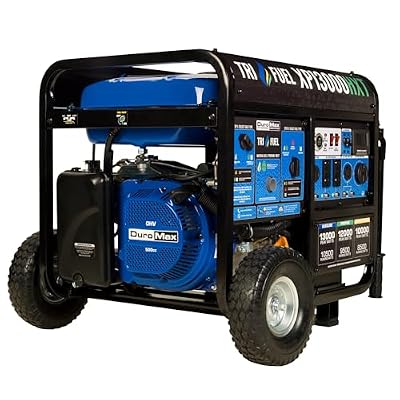
The DuroMax XP13000HXT sits between the other two on natural gas. Its current manual lists 10,500 running watts on gasoline, 10,000 on propane and 9,000 on natural gas. It lists 120/240 V output.
The manual filename marks revision 02072025. The older sales sheet, page 2 gives lower propane and natural-gas ratings. These are current document figures, not proof that every unit has those ratings.
Match your unit's label and manual revision before sizing loads. Starting watts do not promise a motor will start or state how long peak output lasts.
Who it may suit. Compare a checked running load with the current 9,000 W natural-gas rating. That is more output than the Champion and less than the Westinghouse. Confirm the unit revision first. The voltage rating alone does not prove your transfer setup will accept it.
The drawback. The current manual lists 11,250 W starting on natural gas, but the older sheet differs. Check the unit label and matching manual before using that figure. The watt rating does not state a peak duration or prove your motor will start.
This gap matters most if you plan to start motors. A pump or compressor draws more when it starts than when it runs. A running rating cannot show whether that surge fits. Check the generator's surge figure against each appliance's own starting data.
Gas supply check. Get the fuel pressure requirement from DuroMax's exact instructions. Then have a licensed plumber or your gas utility review your meter, regulator and pipe run. Do not modify gas fittings yourself. Do not change regulators or neutral bonding yourself either.
Placement. CPSC rules apply here too. Keep it outdoors, 20 feet from the home, with exhaust aimed away. CPSC's safety alert also calls for a dry surface. It says to install carbon monoxide alarms and move to fresh air if one sounds.
Factors to consider when choosing a natural gas generator for home
Natural gas ratings for these three models
All three picks list lower running watts on natural gas than on gasoline or propane. That holds for these listed models only. Do not assume it for every tri-fuel or dual-fuel model. Size each unit using its own natural gas figure.
The Champion lists 5,875 natural-gas running watts and 9000 starting watts. The current DuroMax manual lists 9,000 running watts and 11,250 starting watts. Westinghouse lists 9,500 running watts and 12,000 peak watts. Keep each fuel and document revision together.
Never use another model's start rating in the DuroMax load plan.
Running and starting arithmetic
First, list every load that will run at the same time. Add their running watts. Call that total R. R must stay within the generator's natural gas running rating.
Next, check starting surge. If motors start one at a time, use this rule. Starting need equals R plus the largest single gap. A gap is one unit's starting watts minus its own running watts.
Some motors may start together. In that case, add every gap for those motors to R. Multiply each gap by the number of units starting. Treat any negative gap as zero.
Do not assume motors never start together.
Avoid two common mistakes. Do not add a motor's full starting watts on top of R. That counts its running watts twice. Also, do not leave its running watts out of R and add only the gap.
Units matter too. The Department of Energy style guide separates power from energy. Watts measure power, and watt-hours measure stored energy. Volts times amps gives volt-amps.
You can convert volt-amps to watts only when the power factor is known.
Gas availability versus usable flow and pressure
Having a gas meter only means gas reaches your address. It does not show what the generator receives. Meter capacity, regulator setting and pipe size all play a part. The length of the run to the generator matters too.
Three separate checks apply. The generator's exact instructions give the required fuel pressure and connection. A licensed plumber or your utility confirms the supply can meet that need. Your electrical source voltage must also match the transfer equipment.
Passing one check does not pass the others.
Natural gas supply can be interrupted, and service varies by address. Do not treat it as guaranteed. Gasoline availability also varies locally during outages.
Voltage, receptacles and transfer equipment
A transfer system keeps utility power and generator power apart. Generac's guidance says the generator, switch, inlet, panel and circuit design must match. Installation belongs to licensed electrical trades. An interlock must be listed or accepted for your exact panel and local rules.
Manual kits vary widely. The Reliance Controls 306CRK is a six-circuit, 30 A kit. It includes a switch, an inlet and a ten-foot cord. The Generac HomeLink 6853 is a 30 A pre-wired manual kit.
Contents lists like these do not prove they suit your home.
Some transfer gear is 120 V. The Reliance TF152W is rated 125 V and 15 A for one circuit. Reliance lists 1,875 maximum generator running watts for it. So 120 V output does not bar every transfer system.
Still, a 120 V source cannot feed 240 V loads.
An RV receptacle does not prove approved home transfer use. Never plug a generator into a wall outlet. CPSC warns that backfeeding is dangerous. Never bypass protective devices.
Automatic standby versus manual portable use
The three picks are portables. By default, a person sets up and starts them during an outage. The Westinghouse page describes an automatic option with a specific transfer system. Whether that option suits your home stays open until you review its exact documents.
Home standby units are a separate category. They are listed here only to show how ratings differ. The Generac Guardian 26 kW sheet lists 22.5 kW maximum continuous on natural gas. It lists 26 kW on propane, rated at 240 V.
The KOHLER 20RCA lists 18 kW on natural gas and 20 kW on propane. Its automatic transfer switch is sold separately on the listed option. The Cummins RS20A brochure lists 18 kW on natural gas and 20 kW on propane. It is a 120/240 V, single-phase unit.
A standby unit's exact clearances come from its own manual and local rules. The portable 20-foot rule does not replace them. Each standby order configuration must be confirmed in its documents.
Equipment cost versus installation cost
The generator price is not the full cost. Generac publishes an indicative US range of $8,000 to $16,000 for a standby project. That covers the generator, system equipment, materials and installation. It is manufacturer guidance, not a quote or a national median.
The page shows no publication date.
Your own total depends on location and site. Fuel line work and permit scope also change it. When you collect bids, ask for line items. Separate the equipment, transfer gear, gas piping, electrical labor and permits.
Itemized bids are easier to compare.
Published-source method
We did not run these generators. Ratings come from maker pages and documents. DuroMax's current manual gives one set of fuel ratings. An older DuroMax sheet differs, so check your unit's revision.
Consider the Champion when R fits its 5,875 W natural-gas continuous rating and S fits its 9000 W starting rating. The current DuroMax manual gives 9,000 running watts and 11,250 starting watts. Westinghouse lists 9,500 running watts and 12,000 peak watts. Check the exact unit, duration and connection before treating any as a complete fit.
If you need hands-free backup, look at standby systems. You can also review the Westinghouse automatic option with its exact documents. In every case, confirm gas pressure and flow, and match the transfer equipment. Licensed trades should do the gas and electrical work.
Natural gas generator for home FAQs
Does gas service at my house guarantee full output?
No. A gas meter shows gas reaches your address. It does not show the pressure and flow at the generator. Meter capacity, regulator setting, pipe size and run length all matter.
Compare your supply against the generator's exact instructions. A licensed plumber or your gas utility can do that check.
How do I check whether my loads will start?
Add the running watts of everything on at once. If motors start one at a time, add the largest single starting gap. A gap is starting watts minus running watts for one unit. If motors start together, add every gap.
Compare the result with the generator's natural gas surge figure.
Can I run a portable generator in my garage?
No. CPSC says portable engine generators belong outdoors, at least 20 feet from homes. Exhaust must point away. Never run one indoors or in a garage, even with the doors open.
This applies on any fuel. Install carbon monoxide alarms and leave if one sounds.
Can a 120 V generator connect to my home?
Some 120 V transfer equipment exists, such as single-circuit switches. A 120 V source cannot feed 240 V loads, though. An adapter cannot add missing voltage. The generator, inlet, switch, panel and local rules must all match.
A licensed electrician should handle the installation.
Can any of these picks start automatically?
The Westinghouse page describes pairing with a specific automatic transfer system, the WATS200. Follow the WATS200 manual for the system's full requirements. Confirm compatibility with exact documents for your generator and panel. Automatic or not, the generator still needs safe outdoor placement, 20 feet from the home.