As an Amazon Associate, this website earns from qualifying purchases.
The short answer
Compare Champion 201176, Westinghouse WGen11500TFc and DuroMax XP13000HXT on the fuel you will use. Their running outputs differ by fuel. Natural gas also needs the required pressure and flow; a supplied hose does not settle installation.
Best tri fuel generator: A tri fuel generator runs on gasoline, propane or natural gas. One engine handles all three fuels. That matters when one fuel runs short during an outage. You pick the fuel you have on hand.
This guide looks at three factory-built models. Each one publishes running watts on all three fuels. You can match a unit to your home circuit plan. You do not have to guess from marketing copy.
Each pick below comes from manufacturer spec pages. We did not test these generators ourselves.
Every running-watt figure here comes from the maker. So does the listed voltage. We have not measured these values ourselves. A missing or disputed figure stays unresolved.
DuroMax is one example of why the exact document revision matters. Its current manual ratings and the older sales sheet differ.
The manual filename marks revision 02072025. The older sales sheet, page 2 gives lower propane and natural-gas ratings. These are current document figures, not proof that every unit has those ratings.
Match your unit's label and manual revision before sizing loads. Starting watts do not promise a motor will start or state how long peak output lasts.
This is not a popularity list. It answers one question. Do a generator's running watts on your chosen fuel cover your essential circuits? We also check the voltage and connection your home can use.
This guide compares factory-built tri-fuel models. It does not rank aftermarket conversion kits. Any conversion needs its own documented model compatibility and safety instructions. The ratings for a factory-built model do not prove that a converted engine has the same output.
Here is a quick look at how the three compare. The Champion 201176 runs 7250 watts on gasoline. It runs 6525 watts on propane and 5875 watts on natural gas. The Westinghouse WGen11500TFc runs 11,500 watts on gasoline, 10,500 on propane and 9,500 on natural gas.
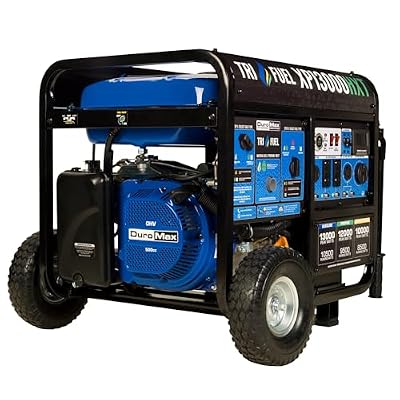
The current DuroMax XP13000HXT manual lists 10,500 running watts on gasoline, 10,000 on propane and 9,000 on natural gas. All three models supply 120/240 volts.
The Champion 201176 is an open-frame inverter. Champion's product page lists 7250 running watts on gasoline. Propane runs at 6525 watts. Natural gas runs at 5875 watts.
All three ratings sit at 120/240 volts.
Each fuel has a separate rating on this model. The gasoline figure is highest in its published table. Propane is next, followed by natural gas. Use the exact figure for your selected fuel.
This comparison does not establish a rule for every engine.
Use this model as a starting point for an essential-circuit plan. List the exact loads you need. Match their running demand to the selected fuel rating. Then check the motor-start scenario and voltage.
The published output does not prove that a fridge or pump fits.
An inverter label describes the output system. It does not prove that every appliance is compatible. Check the exact output limits in the generator manual. Compare them with the appliance instructions.
An open-frame inverter remains a combustion engine and needs safe outdoor placement.
This engine needs outdoor placement. Point the exhaust away from windows and doors. CPSC guidance covers this later in the guide.
It is not a plug-and-play natural gas appliance. A licensed technician should check your gas supply point first. That confirms the published natural gas figure can hold up in real use.
The Westinghouse WGen11500TFc is built for bigger connected loads. Westinghouse's spec page lists 11,500 running watts on gasoline. Propane runs at 10,500 watts. Natural gas runs at 9,500 watts.
All at 120/240 volts.
Peak figures go higher than running figures. Gasoline peaks at 14,500 watts. Propane peaks at 13,500 watts. Natural gas peaks at 12,000 watts.
Peak watts are a short burst rating. The unit does not sustain that output.
Westinghouse publishes up to 19 hours on gasoline at 25 percent load. It lists 9.5 hours at 50 percent load. Those figures have specific test conditions. They do not describe propane or natural-gas runtime.
They also do not promise runtime at your actual mixed load.
Westinghouse lists a dry weight of 230 pounds. Fuel and accessories add to the setup you must handle. Check the route from storage to the running location. Wheels do not remove steps, slopes or soft ground.
Plan handling from the exact equipment instructions and your own limits.
The draw here is capacity. A home with a well pump, a furnace blower and several large appliances has more room with this unit's running watts than with a smaller tri fuel model.
That capacity only helps if your connection can carry the output to your panel. This could be a transfer switch or another setup confirmed by an electrician. A running watt figure on a spec sheet is a screening number. It is not proof the unit will start your specific well pump or heat pump.
Large motors can draw well above their running figure on startup. That surge has to be checked against the unit's starting watts. Do not just assume it will be fine.
The current DuroMax XP13000HXT manual lists 10,500 running watts on gasoline, 10,000 on propane and 9,000 on natural gas. Its rated output is 120/240 volts.
The current manual publishes continuous output for all three fuels. Its natural-gas rating is 9,000 running watts, below the gasoline figure of 10,500. Compare the right fuel rating with your load list.
This guide does not claim its fuel drop is better than every competing model.
The current manual and current product table agree on the ratings above. The older sales sheet differs on both running and starting output for gaseous fuels. That does not prove a change to every physical unit. Check the unit label and matching manual.
The DuroMax offers a larger natural-gas rating than the Champion listed here. It has a smaller natural-gas rating than the listed Westinghouse. Neither fact makes it a universal winner. Compare the output with your demand and the documented fuel supply.
Keep the exact unit revision with the starting check. Do not combine a running rating from one document with a peak rating from another.
Factors to consider when choosing the best tri fuel generator
Load planning for your essential circuits
Start by listing which circuits need to stay on. Think refrigerator, sump pump and furnace blower. Add some lights, maybe a well pump. Add up the running watts those circuits need.
Check that total against the generator's running watts on your chosen fuel. A running watt rating is a screening figure. It tells you if the math could work. It does not tell you whether a specific well pump or heat pump will actually start.
Starting watts are a separate issue. Many motors pull a short surge above their running watt figure when they kick on. The right way to check headroom is simple. Take your running watt total.
Add the single largest gap between one circuit's starting watts and its running watts.
Do not stack every circuit's full starting watts on top of each other. A plan where several motors might start at once needs its own larger calculation. If the generator's starting watt capacity can't clear your combined number, the plan does not work on paper. That holds no matter how the running watts alone compare.
Voltage, fuel supply and gas line requirements
All three generators here output 120/240 volts. That matches standard US home panels. The match is necessary. It is not enough on its own.
The actual connection into your home has to be installed and confirmed by a licensed electrician. This applies whether you use a transfer switch, an interlock, or another method. The electrician checks your panel and local code. We do not give panel or gas line wiring steps here.
That work belongs to licensed trades.
Plan each fuel supply separately. Gasoline needs a safe stored supply or a source you can reach. Propane needs documented cylinder and supply capacity for the chosen load. Local access can change during an outage.
The three models here list lower propane output than gasoline output. Use their propane ratings for a propane plan.
Natural gas needs a compatible supply connection. Its pressure and flow must meet the exact generator instructions. A working household gas line alone does not prove this. Fuel service can also fail during an outage.
Keep gas-supply suitability separate from the electrical voltage and load checks.
Placement, noise and carbon monoxide
Every generator in this list is a combustion engine. It is not a battery power station. That governs where it can sit.
CPSC guidance says portable engine generators must run outdoors. Keep them at least 20 feet from any home. Point exhaust away from windows, doors and vents.
Never run one indoors or in a garage, even with the doors open. This portable rule is separate from standby generator clearance. Standby clearance comes from the exact installation manual and local code.
Carbon monoxide risk is why that rule exists. CPSC safety guidance also calls for carbon monoxide alarms. Get to fresh air right away if an alarm sounds or symptoms show up. Run the unit on a dry surface.
Never touch it with wet hands. Let the engine cool before refueling instead of refueling hot.
None of the three generators here change that math. A tri fuel design does not lower the carbon monoxide risk of combustion. That holds no matter which fuel is running.
Compare sound figures only when the maker gives the measurement conditions. Runtime data cannot establish sound at another load. This shortlist does not rank the three by noise. Output, fuel and connection needs are the supported comparison points here.
A battery power station is a separate option. It has stored energy instead of an engine fuel supply. Its watt-hour capacity is not its running-watt rating. Use its exact instructions for indoor placement and charging.
A battery comparison does not change the outdoor rules for these engine units.
How we compared the published data
Running watts, voltage and weight come from maker pages and sheets. DuroMax ratings follow its current manual. Check your unit's revision against that manual.
We used primary maker records for these ratings. Retailer listings and generic guides can repeat old figures. For DuroMax, the dated current manual supplies one complete set of running and starting ratings. The older sales sheet remains evidence of a revision difference.
Use the matched source set after checking your exact unit revision.
This method means the shortlist reflects what manufacturers currently publish. It is not a lab test. It is not an independent measurement either. If you compare these three against other models, check the manufacturer's current spec page.
Don't trust a listing that might not reflect the latest numbers.
Conditional verdict based on your load and fuel plan
There is no single best tri fuel generator for every home. Consider the Champion when its selected fuel rating fits your running-load list. Check total starting demand as well. A list that names a fridge or pump without its demand is incomplete.
Do not assume it has spare capacity.
If your home draws more, with a well pump, furnace blower and bigger appliances on the list, the Westinghouse WGen11500TFc's higher running watt ceiling is the more realistic starting point. Its 230-pound weight and outdoor placement still need to fit your site.
Consider the DuroMax when its chosen-fuel rating fits your plan. Compare that fit with the Westinghouse and Champion. Confirm the unit revision before using the current ratings. Motor-start timing and the connection still need their own checks.
It does not count as an unlimited surge allowance.
In every case, the final call depends on a load list you build yourself. It also depends on a gas supply checked by a qualified technician. It depends on a connection confirmed by a licensed electrician. A running watt figure alone does not settle it.
That is the honest answer for the best tri fuel generator pick in any single home.
For broader category context, including dual fuel units that run on only two fuels, see our dual fuel generator page. If your home already has a natural gas line, our natural gas generator for home guide covers supply questions in more detail. For propane tank sizing, see our propane generator for home guide.
Keep separate records for each fuel
Use a column for every fuel you intend to use. Record running watts in each column. Add peak watts only where the exact source confirms them. The Westinghouse publishes both running and peak values for all three fuels.
The DuroMax note above gives the current ratings; an older document differs. Match the manual to your unit before finishing the start check.
Do not fill that empty column with a gasoline figure. Do not use a peak value from a similar model. An unresolved start rating can change which unit you choose. It can also change which load group you can plan.
Keep the source date beside the record. Check it again when the manual or model revision changes. If your main fuel changes, repeat the running and startup comparisons. You may need to remove a load from the plan.
A fuel selector does not make every fuel's output equal.
A documented connection is part of the shortlist
Record the voltage your loads require. Record the generator voltage beside it. The listed 120/240 V output is useful for a mixed-voltage plan. It still leaves the receptacle and home connection to check.
A watt rating does not define the inlet rating.
Keep the manual references for the generator and transfer equipment together. The system design must match both. Do not change a neutral bond or bypass protection to make a connection work. This guide gives no wiring steps.
Use the exact instructions and applicable installation requirements.
If the documented connection does not fit, remove the unit from that plan. A large advertised peak number does not repair an incompatible connection. Keep direct appliance cords and connected household circuits as separate use cases. That distinction makes the shortlist useful before any equipment is purchased.
Best tri fuel generator FAQs
What does tri fuel actually mean on a generator spec sheet?
It means the engine is factory-built to run on gasoline, propane or natural gas. Each fuel has its own published running watt rating. The three fuels are not equal in output. Gasoline usually gives the highest running watts.
Propane sits in the middle. Natural gas is usually lowest on the same engine.
Does propane or natural gas lower carbon monoxide risk compared to gasoline?
No verified maker or safety source backs that claim, and this guide does not make it. All three fuels involve combustion. CPSC guidance treats every engine generator the same way. Keep it outdoors, at least 20 feet from the home, exhaust pointed away, never indoors or in a garage.
Can I add a conversion kit to make a gasoline-only generator run on propane or natural gas?
This guide only recommends generators that are factory-built to run on more than one fuel. An aftermarket kit added outside the manufacturer's own design has no primary spec source to check against. We do not recommend that path here.
How do I know if a tri fuel generator will cover my essential circuits?
For one unit starting at a time, first sum the running watts. Find each starting unit's total starting watts minus its own running watts. Add the largest positive difference to the running sum. Check running and startup needs separately.
Several motors starting together require a different scenario and more source data.
Do I need an electrician to connect a tri fuel generator to my home panel?
Yes, for any permanent or transfer-switch connection into your panel. Generator capacity, switch rating, inlet and panel design all have to match. That work, along with any gas line connection, belongs to licensed electrical and gas trades following your exact local code.
Are the running watt figures on the spec sheet what I'll actually get at my house?
Published running watt figures come from manufacturer testing under their own stated conditions. Your real output depends on fuel supply quality, altitude, temperature and connection method. Treat the spec sheet number as a planning ceiling confirmed by a qualified technician, not a guaranteed result at your house.