As an Amazon Associate, this website earns from qualifying purchases.
The short answer
Choose iGen2550DFc for light plug-in loads. Champion 201176 and DuroMax XP13000HXT suit larger designed connections. All accept gasoline and propane; the larger two also support natural gas. Use the output rating for your chosen fuel.
A dual fuel generator runs on gasoline or propane. One machine covers two fuel choices during a home outage. Gasoline can run out fast in a wide outage. Propane tanks can sit in storage until you need them.
This guide compares three dual fuel generator options. We use separate gasoline and propane ratings for each. We also cover runtime and refueling choices. These details decide which fuel fits your home.
Each model here makes less continuous power on propane than on gasoline. That pattern holds for these three units. Use the running watts number for the fuel you plan to use. Don't rely on the higher gasoline figure printed on the box.
The iGen2550DFc is a compact dual fuel generator. It suits light loads. It is not built for whole-house backup. On gasoline it runs at 1900 W, with a 2550 W peak.
Switch to propane and running output drops to 1700 W, with a 2300 W peak.
That drop matters if you plan to run a fridge plus small electronics. Output is 120 V only. It connects through standard outlets and an RV-style plug. Westinghouse states the included RV TT-30R outlet is not transfer-switch-ready.
An RV-style outlet alone does not prove a home connection is approved. Match the exact generator manual to the transfer equipment. Westinghouse labels this model as not transfer-switch-ready. Do not assume its RV outlet can feed a home inlet.
For a pump or furnace, first record the actual load and voltage. Check both running demand and total starting demand on propane.
For a router or a lamp, check the actual input rating first. Add everything that stays on at once. The gasoline ceiling is 1900 running watts. On propane it is 1700 running watts.
Those numbers can screen a small plan. They do not prove that any named appliance will run or start.
Think through the outage order before buying this size of unit. If a storm knocks out power overnight, you will likely start on whatever fuel sits in the tank. You can decide later whether to keep running gasoline or switch to stored propane. Because the outlets are not transfer-switch-ready, every appliance plugs in directly.
Use an outdoor-rated extension cord for that.
Plan cord routing and distance from the unit ahead of time. CPSC guidance calls for placing portable engine generators at least 20 feet from the home. Point exhaust away from the house. That rule applies even to a small inverter generator like this one.
The Champion 201176 is a bigger, open-frame unit. It offers three fuel choices instead of two. Champion lists 7250 W running on gasoline. Propane output is 6525 W.
Natural gas output is 5875 W. All three figures come from one engine.
Output is 120/240 V. That matters if you want to power 240 V gear through a proper home connection. A well pump or AC compressor falls into that category. The natural gas option only helps if your home already has a gas line in place.
Propane cuts running watts here compared to gasoline. If propane is your planned fuel, size your circuit list against the 6525 W figure. Don't use the 7250 W gasoline number for that math.
This is an open-frame engine unit. CPSC carbon monoxide guidance says to run it outdoors, at least 20 feet from the home. Point the exhaust away from doors and windows. Never run it indoors or in a garage, even with the door open.
Feeding a home panel safely needs a transfer switch or interlock. A licensed electrician must install that equipment. Champion's documentation covers the generator's own output. It does not cover how to wire it into your house.
The fuel choice here carries real trade-offs. Gasoline gives you the highest running watts figure. But it also means storing and rotating gas cans. Propane means a lower ceiling on running watts.
It can sit in a tank through a long outage, though.
Natural gas removes the refueling task if a line is already plumbed in. It also delivers the lowest running watts of the three options. Your circuit list has to shrink to match that lower number.
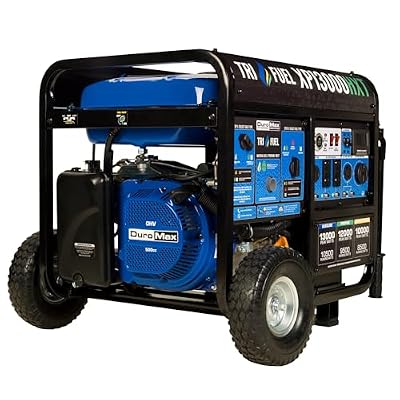
The DuroMax XP13000HXT has the largest running rating in this comparison. It runs on gasoline, propane or natural gas. Its current manual lists 10,500 W running on gasoline and 10,000 W on propane.
The manual filename marks revision 02072025. The older sales sheet, page 2 gives lower propane and natural-gas ratings. These are current document figures, not proof that every unit has those ratings.
Match your unit's label and manual revision before sizing loads. Starting watts do not promise a motor will start or state how long peak output lasts.
The current natural-gas running rating is 9,000 W. The manual lists 120/240 V output.
Compare the chosen fuel rating with your own circuit list. The DuroMax manual above gives the current ratings, and an older sheet differs. The exact unit revision and motor-start demand still need checks.
The running watts figures above are the solid comparison point across fuels. Like the Champion unit, propane and natural gas both cut output compared to gasoline. Check the manufacturer's table above before sizing your load list.
This is also an open-frame engine generator. The same CPSC placement rule applies here too. Keep it at least 20 feet from the home, with exhaust pointed away. Never run it in a garage or indoors.
A generator this size is usually paired with a transfer switch or interlock. That setup can let it feed part of your home panel, if the exact equipment and wiring support it. That wiring job belongs to a licensed electrician. It should follow local code and the product manual.
It is not a do-it-yourself project.
A unit this large changes your planning timeline too. Moving and positioning a generator this heavy takes more than one person. Decide ahead of time where it will sit. Plan how exhaust will point away from windows.
Think through how cords or conduit will reach a transfer switch.
If propane is your intended fuel, confirm tank size and refill access before the season starts. A bigger running watts figure on propane still drains a larger tank faster under heavy load.
Factors to consider when choosing a dual fuel generator
Load planning by fuel
Start with a list of the circuits or appliances you want to run during an outage. Add up their running watts. Flag any motor-driven items that need extra power to start.
A running watts figure is only a screening number. It does not prove a specific well pump or fridge will actually start. Real startup current depends on that exact appliance's own design. Size your plan against the propane running watts figure if propane is your fuel.
Starting watts matter on their own. The right way to check headroom is your running total plus one extra amount. That extra amount is the single largest gap between one appliance's starting watts and its own running watts, for one unit starting at a time. Don't add every appliance's full starting watts stacked on top of each other.
Motors do not always start one at a time. If several appliances might start together, that scenario needs its own separate calculation.
Small dual fuel units like the iGen2550DFc put out 120 V only. That limits them to standard outlets and plug-in loads. Bigger dual fuel and tri-fuel units, including the Champion 201176 and DuroMax XP13000HXT, put out 120/240 V. That output is what a transfer switch or interlock setup needs to feed select 240 V circuits, once a licensed electrician confirms the exact equipment matches.
Fuel supply works differently between gasoline and propane. Gasoline sits in portable cans. Most households can only store so much safely. Supply can get shaky during a wide outage, when gas pumps lose power or lines form.
Propane in refillable or exchangeable tanks can be stocked ahead of time. Keep cylinders upright and outdoors, away from living space and ignition sources. Store gasoline only in approved containers, outside the home. Both need their own space and handling care. Switching a dual fuel engine between fuels follows the exact steps in that unit's manual.
Runtime and refueling planning before an outage
Use the generator running cost guide to compare operating inputs once the selected fuel and load are clear. Keep fuel expense separate from the purchase and connection budget.
Usable runtime on any fuel depends on tank size and how hard you run the unit. Running watts and runtime trade against each other. A generator loaded closer to its maximum running watts burns fuel faster than one running a lighter load.
Before an outage, decide which circuits are truly essential. A smaller load list stretches your fuel supply further, no matter which fuel you pick.
Refueling constraints differ by fuel. Gasoline refueling means shutting the engine down and letting it cool first. CPSC guidance warns against hot refueling. Time refuels during a lull rather than waiting until the tank runs dry overnight.
Keep enough fuel for the plan you wrote down. Check which local suppliers can refill or exchange your cylinder. Do not assume they can open during an outage. Follow the exact manual for changing fuels and handling connections.
Never change a fuel setup just to keep a hot engine running. Plan safe shutdowns and cooling breaks before you need them.
Outdoor placement rules
Any engine-driven generator burns fuel and produces carbon monoxide. CPSC guidance is clear on this point. Run portable and open-frame engine generators outdoors, at least 20 feet from the home. Point exhaust away from windows and doors.
Never run one indoors or in a garage, even with the door open.
This rule applies to the Champion 201176 and DuroMax XP13000HXT here, since both are open-frame engine units.
A battery power station works differently. It has no engine and no exhaust, so this outdoor rule does not apply to it. Units like a 2048 Wh or 2042 Wh battery pack follow their own manufacturer instructions instead. A battery's stored energy in watt-hours is a fixed budget.
It is not a fuel-replenished supply. It runs down and needs recharging, not refueling.
If you want a non-combustion backup option alongside or instead of a dual fuel generator, that choice is worth comparing separately.
How we checked these numbers
Running watts, starting watts and voltage come from the named maker records. DuroMax ratings follow its current manual and product table. An older DuroMax sheet differs, so check your unit's revision. Safety guidance comes from CPSC.
This method keeps each fuel rating tied to its own source. It avoids blending gasoline and propane numbers into one average. It also avoids filling gaps with assumed figures.
How this changes your pick
Pick the iGen2550DFc only for a short list of plug-in loads. It needs no home panel connection. Choose the Champion 201176 if you want 120/240 V output for a transfer switch setup. Add outdoor placement and a professional electrical hookup to that plan.
Go with the DuroMax XP13000HXT if your circuit list is larger and you want the same fuel flexibility at higher output.
Every engine pick needs safe outdoor placement. A home-panel route also needs matching transfer equipment. Direct appliance cords are a different route. Follow their ratings and the generator manual.
Choosing a bigger unit does not settle either connection question.
If you're still deciding between gasoline-only, propane-only or dual fuel, check the broader best generator for home buying guide for a wider comparison. If you're weighing propane storage against gasoline storage, read the propane generator for home page. Curious how a natural gas line changes things? See the natural gas generator for home guide.
Keep the same load plan on your second fuel
A second fuel helps only if it can support your chosen loads. Write a separate load limit for each fuel. The Champion has 7250 running watts on gasoline. It has 6525 on propane.
A plan that fits the first figure may exceed the second. Keep both figures beside your circuit list.
Decide which loads can wait if you change fuels. Record that choice before an outage. A person reading the plan should see what stays on. They should also see what must stay off.
Do not rely on a memory of the larger number on the box.
Starting demand still needs its own check. A smaller running load does not prove a motor start fits. Compare the total start scenario with the rating for that fuel. If the manual omits the needed start data, keep that part unresolved.
Do not treat a missing figure as spare power.
Make your source record easy to check
Record the exact model beside each rating. Include the fuel and the source date. Save the manual reference for that model revision. A similar name on another listing can describe a different unit.
Keep the three fuel columns separate when the model supports three fuels.
Record your appliance data with the same care. Note whether the value is running watts or total starting watts. A value in volt-amps is a different measure. You need a known power factor to turn it into watts.
Do not quietly relabel it.
Use the record when your plan changes. Adding one load can change the running sum. Adding a motor can change the start scenario. Changing fuel can lower the source rating.
Recheck those specific changes before you run the equipment. The source record makes each assumption visible instead of hiding it in a product label.
Dual fuel generator FAQs
What is the real difference between a dual fuel generator's gasoline and propane ratings?
Each model in this guide makes less running watts on propane than on gasoline, based on its own manufacturer spec sheet. The exact gap varies by model, so check the specific numbers above rather than assuming a fixed percentage. Always plan your load list against the propane figure if propane is your fuel.
Can a dual fuel generator run safely inside a garage?
No. CPSC guidance says portable and open-frame engine generators must run outdoors, at least 20 feet from the home, with exhaust pointed away from doors and windows. This applies even with the garage door open. Carbon monoxide can still build up in and around an attached structure.
Does a dual fuel generator need a transfer switch to power my home?
Bigger 120/240 V dual fuel units are usually paired with a transfer switch or interlock to feed select circuits in a home panel, when the exact equipment and wiring support that connection. Small 120 V-only units like the iGen2550DFc are not built for that connection. A licensed electrician should size and install any transfer switch based on the generator's manual and local code.
How do I calculate starting watts headroom correctly?
Add up the running watts of everything you plan to run at once. Then add the single biggest gap between one appliance's starting watts and its running watts, for one unit starting at a time. Don't add every appliance's full starting watts together. If several motors might start together, work out that scenario separately.
Is a battery power station a substitute for a dual fuel generator?
A battery power station stores a fixed amount of energy in watt-hours and has no engine. The CPSC outdoor placement rule for engine generators does not apply to it. It needs recharging instead of refueling. Its usable runtime depends on its stated capacity and the load you connect, following its own manufacturer instructions.
What output does a dual fuel generator need to match my well pump or fridge?
A compatible running watts number only screens a generator as possibly suitable. It does not guarantee your specific fridge, pump or other motor will start. Startup current depends on that exact appliance's own design. Check your appliance's documentation and compare it against the fuel-specific running and starting watts figures above.
Compare three dual fuel inverter generators by gasoline and propane ratings, voltage and outlets. Learn how to check whether propane output starts your loads.
Compare three propane-capable portable generators by propane running watts, voltage and documented limits. Learn about startup math, tank runtime and standby differences.